Recently, an open letter was sent to councillors of Adur District Council and West Sussex County Council, from a small group called ‘The USR Action Group’.
The group opposes plans to create cycle infrastructure on Upper Shoreham Road, and its letter called upon councillors to abandon such plans, and to look instead at the A259.
Though everyone is entitled to share their opinion with councillors, we felt there were enough misconceptions within the group’s letter that we decided to write our own letter – also sent to all councillors.
Here is the text of our open letter:
Dear Councillors
We write in response to the open letter sent to councillors from a small group called the USR Action Group.
While of course we applaud reasonable communication between citizens and elected representatives, it seems there are a number of unfortunate misconceptions and ill-founded claims within the letter, as well as an uncomfortable suggestion that council tax banding may have a bearing on the weight that should be afforded to residents’ opinions.
We hope here to offer some corrections and clarifications.
We are Shoreham-By-Cycle – a group of nearly 100 members, representing a broad spectrum of local people. We have members living on Upper Shoreham Road, in other parts of Shoreham and a small number who live in surrounding suburbs, towns and villages, who make their journeys to or through Shoreham.
Many of our members are parents whose children travel to the numerous schools that are reached via Upper Shoreham Road, including Sir Robert Woodard Academy, attended by an ever-increasing number of Shoreham children.
We are united in our desire for travel within and around Shoreham to be safer and easier.
Upper Shoreham Road or A259, or both?
USRAG’s letter queries the selection of Upper Shoreham Road as a candidate for improvements – in comparison with alternative routes.
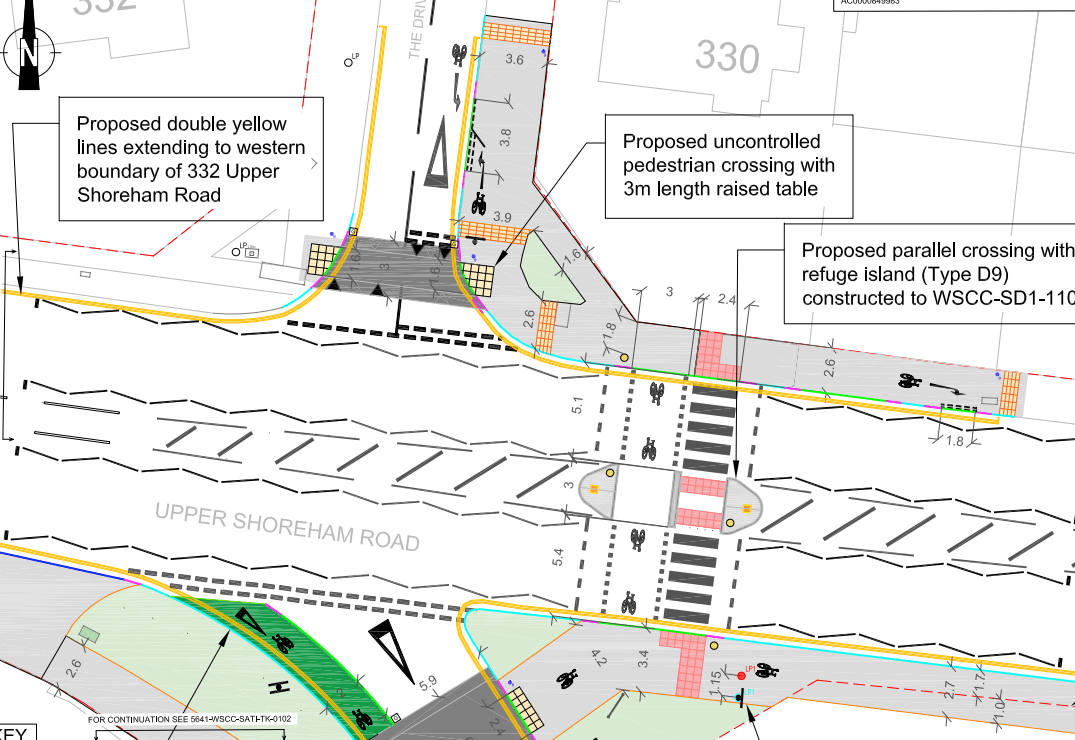
For over 25 years, a cycling network has been planned for Shoreham by Sea. It is self-evident that a network, not a singular route, is needed in order to enable people’s diverse journeys, and this is reflected in the numerous strategies and documents that have repeatedly defined Upper Shoreham Road as a primary route within such a network. Upper Shoreham Road has not simply been chosen on a whim: its selection is the result of repeated and thorough research, not least through the Department for Transport’s sophisticated ‘Propensity to Cycle’ Tool and Adur and Worthing Councils’ Local Cycling and Walking Infrastructure Plan.
Specifically, USRAG’s letter mentions the A259 Brighton Road. This is the other of the two significant east-west routes defined in strategies as being ‘primary’ in its priority.
Two points of note about the A259:
Firstly, the A259 is a very different kind of road to Upper Shoreham Road, serving a very different purpose. It forms an important commuting route for middle-distance journeys, connecting Shoreham to its neighbouring towns and suburbs to the east and west. But being south of the railway line which severs parts of Shoreham, the A259 is of very limited utility for most journeys that take place within the town itself – in particular, thousands of everyday journeys to multiple schools.
Secondly, it is widely known that consultation is already underway with a view to the eventual format and design of an A259 cycleway. But with years of construction work lying ahead for the western harbour arm, councillors and council officers have made clear that this route will not be ready for the installation of cycle infrastructure for quite some time – maybe five to ten years.
The A259 does indeed deserve to be improved and made safe for journeys by cycle. But this in no way detracts from the pressing need to update Upper Shoreham Road: a street that hosts thousands of short journeys every day for school, work, shopping and leisure, and whose current layout still incongruously harks back to its identity 50 years ago as a trunk road.
While the A259 faces years of residential construction and disruption, Upper Shoreham Road does not. It is ready for updates now.
Support for progress
USRAG’s letter suggests that there is not “a clear body of support” in favour of upgrades to Upper Shoreham Road. This is not accurate.
In the most recent WSCC consultation, levels of support and opposition for proposed measures on Upper Shoreham Road were both recorded at 48% each. It does seem that levels of opposition are sometimes rather overstated by those who are uncomfortable with the swell of public opinion in recent years towards safe active travel.
Further to the above, firm and repeated Department for Transport guidance to WSCC and other authorities states that “consultations should not be treated as referendums”.
WSCC’s multiple Upper Shoreham Road consultations, rather than acting as referendums, have quite rightly enabled the council to take on board specific concerns and ensure these are addressed within eventual designs. With attractive design and ample provision of spaces for parking cars, the most frequently cited doubts are thus addressed.
The Department for Transport also points out to WSCC the well-known (and evidenced) fact that after improvements such as these are completed, levels of public support for new infrastructure continues to grow considerably. Shoreham’s own East Street was a close-to-home example of this phenomenon over a decade ago.
Support comes also from our elected representatives. Upper Shoreham Road is defined as a primary route within Adur and Worthing Councils’ Local Cycling and Walking Infrastructure Plan. This strategic document was consulted upon comprehensively among local residents, and district councillors unanimously accepted its adoption in 2020. The plan was reaffirmed this year by Adur District Council, only weeks ago, with, once again, huge cross-party support for a motion that highlighted Upper Shoreham Road as a priority – and with not one councillor voting to oppose.
Value for money
USRAG’s letter then moves on to questions of value for money. This is not a topic on which we have heard the group comment before.
Some points to consider:
The sums of money being discussed – to come from central government funds, not from local budgets – are a fraction of the costs of many other highways schemes: a balance sheet upon which roundabouts can habitually cost £30million, and simple junction upgrades alone can be priced in millions. By any standard of government spending, the improvements being proposed for cycle infrastructure are reasonably priced.
But of course, value for money and price are not the same thing.
Well-designed, well-planned and well-implemented cycle schemes have been found to be among the best value for money of any government spending, due the way such projects bring benefits for safety, commerce, health, congestion, planning, environment and numerous other measurable outcomes.
Value for money is nevertheless a complex calculation, perhaps deserving of more expertise than can be provided by the guesswork of any involved in the local conversation. This expertise is in the hands of government funding body Active Travel England, who use sophisticated tools and calculations to decide whether or not a proposal delivers a good return on investment. If ATE’s specialists do not consider a project to be good value for money, they will not fund it.
It should be noted however, that ATE is not averse to projects with notable price tags, as can be seen from successful work it has funded (as DfT) in numerous other towns. For this reason, a full proposal for Upper Shoreham Road cycleways must be put to Active Travel England as a matter of urgency. Expert judgement is needed now to appraise both design and value for money – and ATE cannot judge a bid they have not seen.
Other measures for Upper Shoreham Road
USRAG’s letter proposes measures such as 20mph limits and speed bumps for Upper Shoreham Road. Such interventions can certainly have value on certain types of street, in certain contexts. Upper Shoreham Road is not one such context. It is a vital distributor road within Shoreham, which clear DfT and WSCC design guidance makes clear is suited to separated cycle infrastructure rather than interventions designed for much smaller, quieter roads.
A duty to all
In closing, we cannot help but take firm exception to USRAG’s suggestion that there is relevance in the idea that “many [Upper Shoreham Road residents] pay a higher than average amount in local council taxes in support of the work of the local authority”.
The concept that a resident’s wealth should give them greater influence in the decisions made by their elected councillors is something with which we cannot agree. Legally, WSCC has an obligation, known as its Network Management Duty, to facilitate the safe movement of people on the roads within its purview. This duty relates to all people using a road, regardless of where they live, the origin or destination of their journey, or the level at which they (or their parents) pay council tax. To suggest otherwise would be deeply inappropriate.
In conclusion
After years of planning, multiple consultations, clear repeated government instruction and now the imminent availability of funding, it really is time Shoreham was allowed to catch up – by using available government funds to bring a long-awaited start to its cycle network.
The clear evidence-driven and practical starting point for that network is Upper Shoreham Road. A full funding bid for Upper Shoreham Road’s cycleways – not a watered-down phased approach that delays any cycling improvements for still more years – must therefore be submitted, in good faith, to Active Travel England at the earliest opportunity, so that its value for money can be determined.
We remain available to assist in any way we can as councillors and officers work to bring our streets up to date.
Sincerely,
Shoreham-By-Cycle








 SHOREHAM-BY-CYCLE